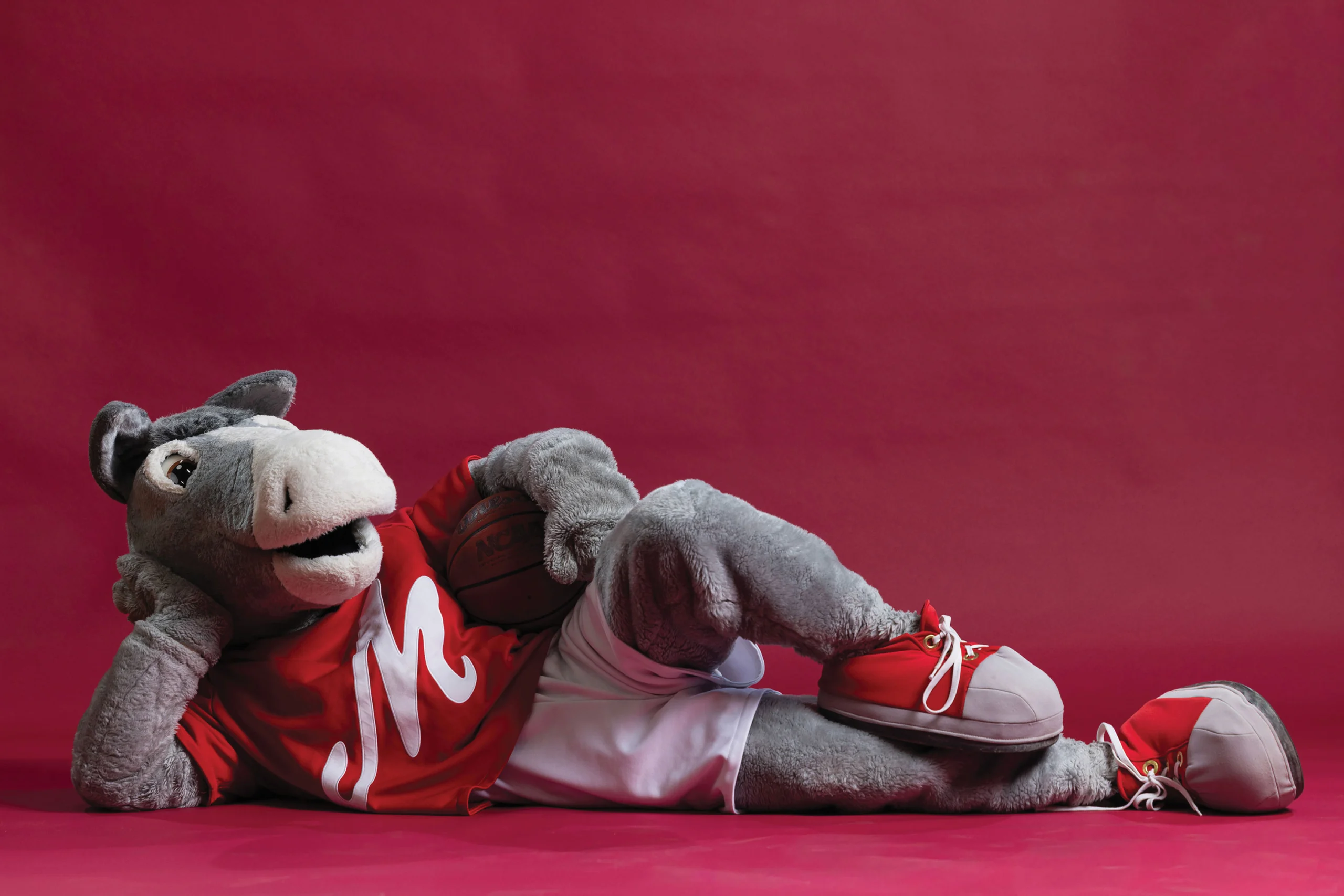
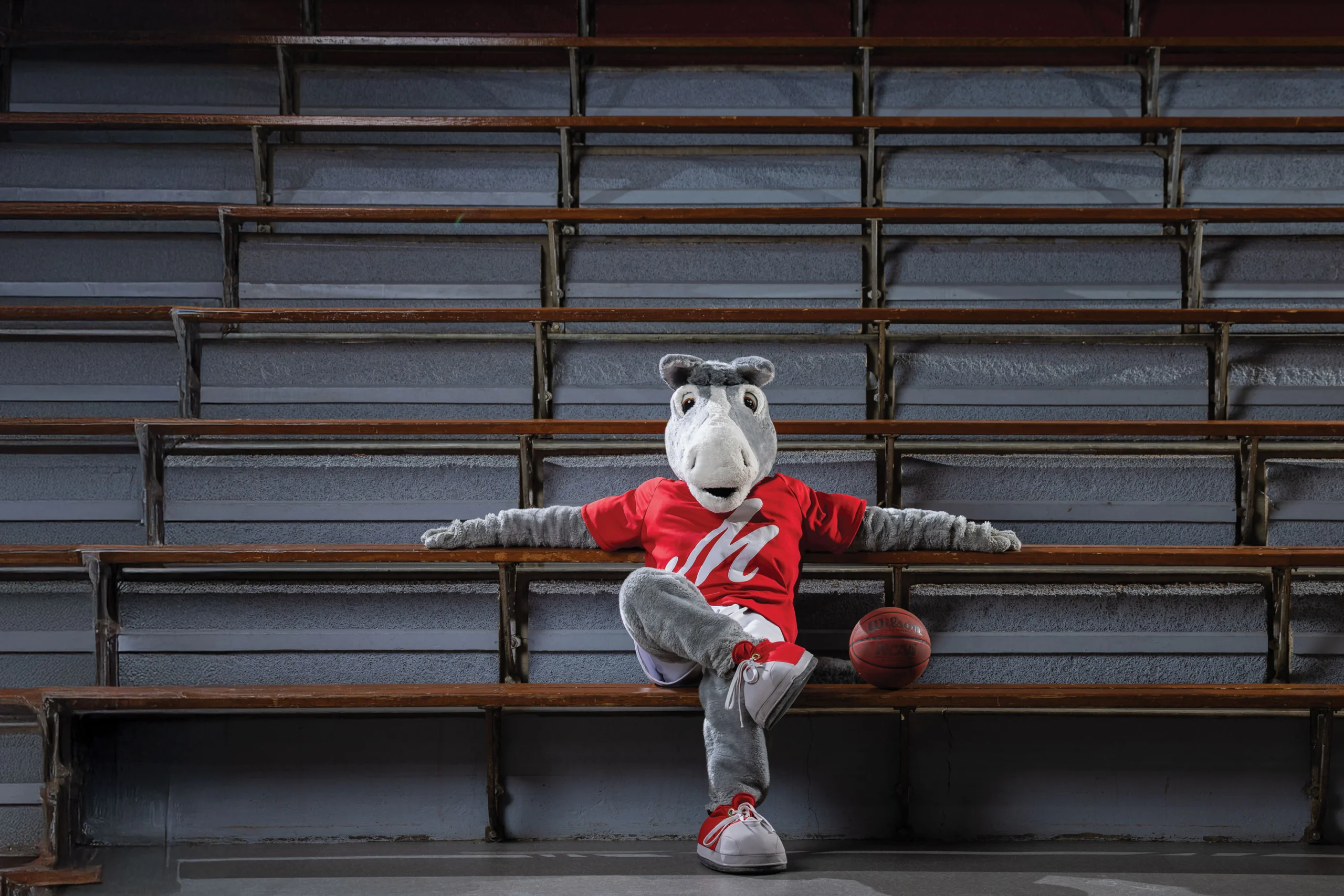
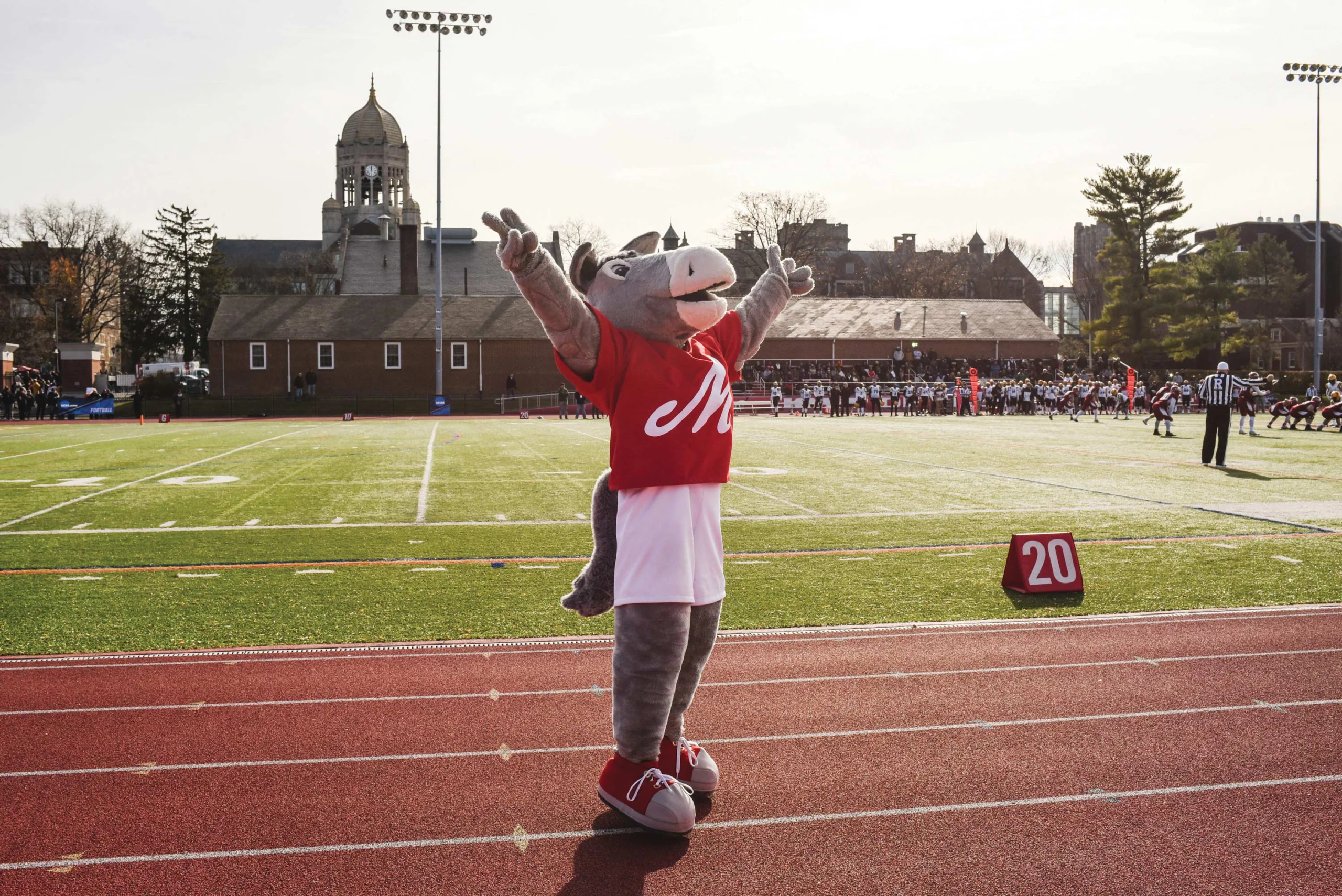
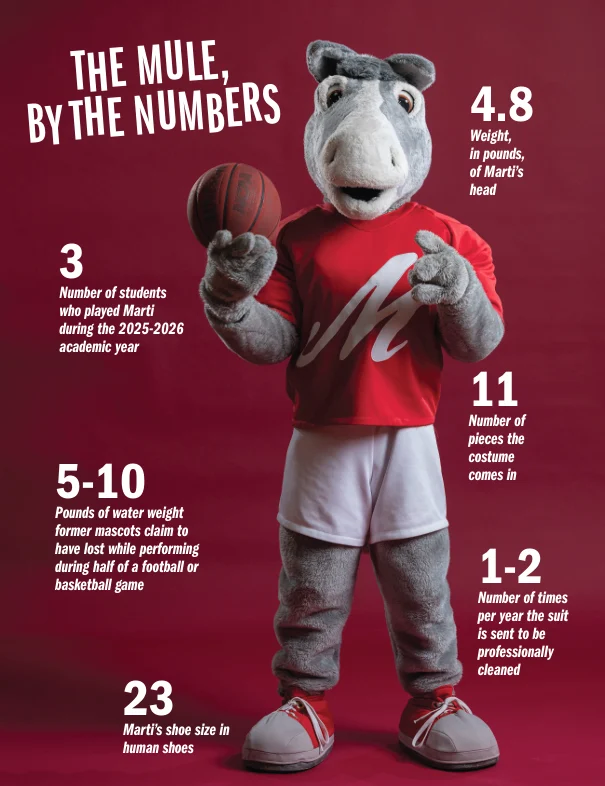
If you’ve been on campus in the last decade for a homecoming fair or a football game, you’ve likely encountered Marti the Mule. Marti is gray, furry, and sometimes a little disoriented. (It is really hard to see out of that mule head.) But, more than anything, Marti is the ultimate cheerleader for Muhlenberg — bringing smiles to the faces of fans of all ages, doling out high fives and hugs, and generating a sense of team spirit the way only humans wearing ridiculous costumes can.
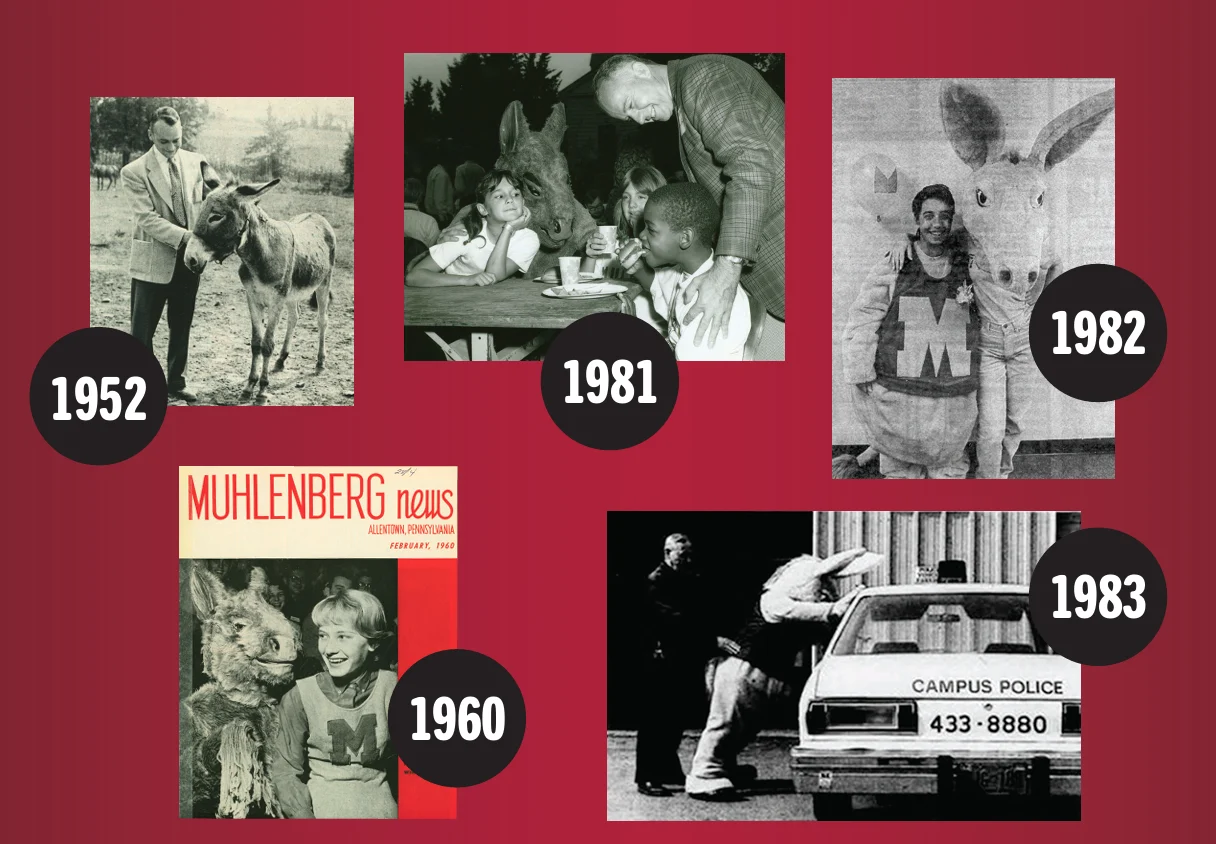
It wasn’t always this way. Alumni from the 1950s and earlier may remember a time before the advent of costumed mascots, when live mules attended both home and away football games. Go back further in the archives and you’ll find that Muhlenberg’s athletic teams weren’t always known as the Mules and that early teams had dogs and even children as their mascots.
“Who doesn’t love a mascot?” says Director of Athletics Lynn Tubman. “Mascots always seem to elevate the energy and school spirit at every event they attend, and Marti does that so well. Our student-athletes and fans are always excited to see Marti at our contests, rallying the crowd and bringing our community together.”
If the Muhlenberg mule also sparks joy in you, join us as we explore how we came to have such a distinctive and memorable mascot.
Marti the Mule in 2026
Living Things (Not Mules)
In an 1899 article in the student publication that was then called just The Muhlenberg (it became weekly in 1914), G. Wellington Lutz, Class of 1901, wrote, “A mascot is anything that brings good luck — if there is such a thing as luck.” At first, what brought teams luck seemed to be children. Archives of the Weekly and the Ciarla yearbook document more than one child serving as the football team’s mascot from the late 1800s through the early 1940s, including Truman Koehler Jr. ’52, the then-10-year-old son of then-Professor of Mathematics Truman L. Koehler Sr., Class of 1924.
“The two things my father talked about in connection with this were how many broken noses there were due to not having a face mask — just leather helmets — and how many ‘new words’ he learned,” says Truman Jr.’s son Jeff Koehler ’79, who is currently a Muhlenberg trustee.
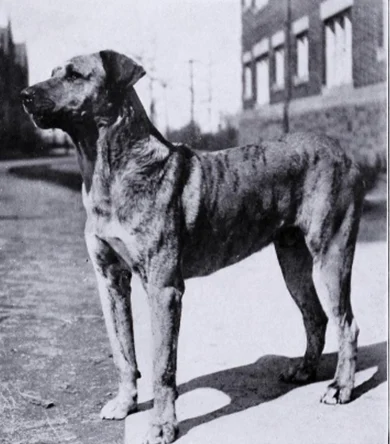
Dogs were also popular as mascots in the early 1900s, and not only at Muhlenberg: Yale University was the first American college to have a mascot, a dog they called Handsome Dan who attended all football and baseball games. (Today, Yale has Handsome Dan XIX — that is, 19 — one of the now less common live animal mascots still in the business.) Muhlenberg’s first dog mascot on record was a Great Dane named Dutch (pictured above), who joined the college for the 1911 football season. Another dog, King Solomon, was the athletics mascot in the early 1920s. Canine mascots weren’t only for athletic teams, either: Muhlenberg fraternities in this period frequently had dogs as mascots, and in 1945, a unit of the Navy attending Muhlenberg had a Chesapeake Bay retriever named Rusty as its mascot.
A 1926 Muhlenberg Weekly article laments the lack of a mascot at that time and proposes a new one: “Our school colors suggest a very likely symbol, for our benefit, even if it should be a little difficult to use for a mascot. The Cardinal is a very pretty bird … and even if its habitat does not suit it for use in these climes as a mascot, its figure would do very creditably on banners and other insignia.” The writer suggests a mounted cardinal — nothing excites sports fans like taxidermy! — and concludes, “We can in no wise afford to be behind others who have symbols or other objects of admiration. Let’s have the Cardinal for our standard.” And we did, at least for some time, as evidenced by baseball team photos with the word “Cardinals” emblazoned on the jerseys.
Muhlenberg’s first dog mascot on record was a Great Dane named Dutch (pictured above), who joined the college for the 1911 football season. Another dog, King Solomon, was the athletics mascot in the early 1920s.
Living Mules
The first recorded mention of using a mule as a mascot comes from the October 6, 1927, issue of The Muhlenberg Weekly: “There is a mule in Muhlenberg. So our opponents on the gridiron after feeling our kick tell us. Why not buy one and have it as our mascot. Besides there are plenty of freshmen who know how to handle them.”
The first time students actually implemented this idea was two seasons later, in 1929, with both The Muhlenberg Weekly and The Morning Call referring to a live mule, named “Paddock Schneck” according to the Call, attending football games. John Hollenbach ’34 donated a photo album to the Trexler Library archives that contains a photo of a live mule tied to a fence on campus.
In a confusing juxtaposition, the October 6, 1937, edition of The Muhlenberg Weekly contains a photo of fifth Muhlenberg College President Levering Tyson meeting “the mule” — unclear whether it was the same one — on the same page where the main headline reads “Cardinals Trounce Larries 18-6.” The same article also refers to the team as the Mules.
In 1952, the student body purchased a new live mule and held a naming contest. Albert Schrum ’54 came up with the winning name — General Pete — and won several prizes, including free dry cleaning, a fountain pen, and a “choice sirloin steak dinner.”
The college would cycle through several live mules in the next few decades. The Muhlenberg archives include a receipt dated October 16, 1947, that reads, “Received from Muhlenberg College the sum of fifty dollars ($50.00) cash as payment in full for one mare mule.” Two years later, Lewis Trumbore ’49 wrote “the story of the only co-ed at Muhlenberg” — the college wouldn’t become coeducational until 1957 — in the May 19 Weekly. It was all about Judy, this first mule that the college had purchased (prior mules had been rented). During the football season, Trumbore wrote, Judy lived in a stall at the fairgrounds at a cost of $1 per day — $13.87 in today’s dollars. In the off-season, “rather than raise the tuition again, the college felt that some better arrangement had to be made.” A groundskeeper’s brother took Judy to his farm and kept her in exchange for her work. She served one more football season and was replaced by another mule named Jingo in 1950 for reasons unclear.
In 1952, the student body purchased a new live mule and held a naming contest. Albert Schrum ’54 came up with the winning name — General Pete — and won several prizes, including free dry cleaning, a fountain pen, and a “choice sirloin steak dinner.” Other name options included Boots, Avalanche, Surprise Attack, Winberg, and Bergermeister. The Weekly wrote more than once about needing to raise funds to send the live mule to away football games. An October 1, 1953, story in the Weekly — headlined “GENERAL PETE IS EXPECTING” — indicates that Pete was not a mule but a donkey. (Mules, which are a cross between a horse and a donkey, are sterile.)
General Pete was the last live mule mentioned extensively in the Weekly. Local newspapers referred to two more — Mr. Henry in 1957 and Pancho in 1959 — before the era of costumed mascots began.
The First Three Mule Costumes
The February 11, 1960, edition of the Weekly includes a small box that begins, “Student council is organizing a Mascot committee to operate Muhlenberg’s newly acquired Mule costume.” A student in that costume appeared on the cover of the February 1960 issue of Muhlenberg News, that era’s alumni publication, lurking behind a cheerleader and holding a mop-like pom-pom.
Muhlenberg was on the leading edge of the move toward costumed mascots. An article by Jeff Vrabel in the summer 2017 edition of the NCAA’s Champion magazine dives into the history of college sports mascots. Vrabel writes, “The early ’60s also began a shift from live to costumed mascots, the first of which were (probably) Brutus Buckeye and Major League Baseball’s Mr. Met, who both debuted in 1964.” Mascots took off at the professional level in the 1970s, with the San Diego Chicken in 1974 and the Phillie Phanatic in 1977.
This first mule costume was heavily used: It lasted from 1960 to 1982, freshened up by at least one new paint job around the eyes and snout along the way, among other repairs.
“The original mule costume was on its last legs,” recalls Mark Paris ’80 P’16, a former Muhlenberg mascot who’s now managing partner at Creative Climate Capital and an emeritus trustee. “It was stitched together in some places and looked more like a mule that had been starved and neglected. Having one’s head inside a costume that trapped the steam of many heads of hair was not pleasant. It required frequent breaks to run next to the stands and remove my mule head to catch a breath.”
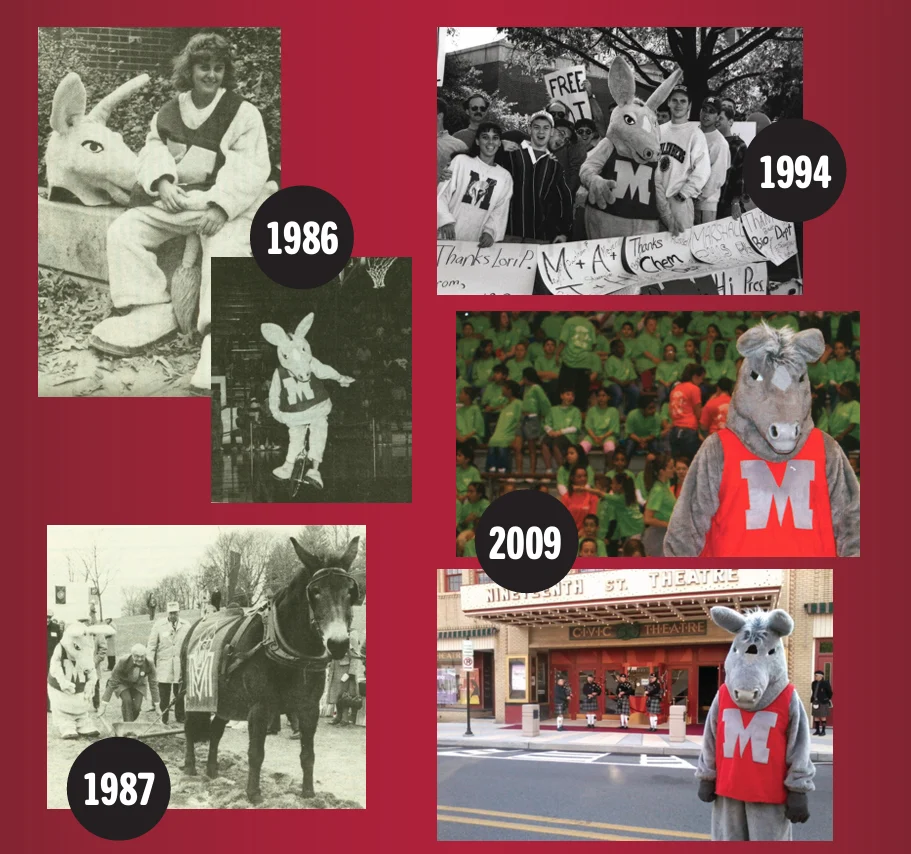
An October 28, 1982, article in The Morning Call debuted a new mule costume, a pear-shaped, bunny-eared version that cost the athletic department $2,000. Posing in the body of the suit was Diana Megna ’84 and, in the head, Linda McMullen ’83. This mascot featured prominently at sporting events, college milestones, and elsewhere — it even went to Harrisburg to meet then-Governor Richard Thornburgh — and many alumni fondly remember their time inside this costume.
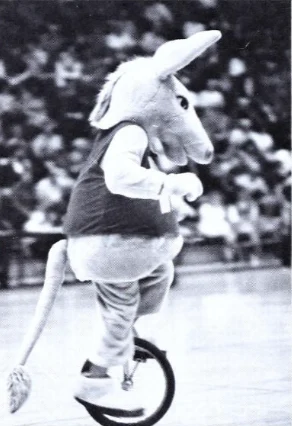
Mitch Brill ’86, now a partner/founder at Altium Wealth, became known for his ability to ride a unicycle from one end of the basketball court to the other while in costume. He remembers mascotting as “a license to pick on anyone you wanted to without any repercussions,” usually the referees. He’d point to an imaginary stain on their shirt and bonk them on the nose when they looked down, or take a Polaroid photo of them and, after it developed, drop it on the ground and stomp on it.
“I was class president and senior grad speaker … and I did a lot of other things,” Brill says. “I would’ve traded all those things for the mule.”
Randi Schweriner ’87, now CEO of Campus Innovation, had to be the mule for the second half of football and basketball games during the years when Brill had seniority. It was harder for her to do tricks as the mule — “I’m only 5-1, so I was a little short for the suit,” she says — but she enjoyed jumping around, cheering, and being anonymous.
“The most fun was when people didn’t know who it was,” she says. “I could walk up to somebody and give them a big hug or whatever and they wouldn’t know what to do because they didn’t know it was me. It’s really fun not to be you for a while.”
Michael Lefkowitz ’91, who was the mule during his sophomore-year orientation and that football season, is a full foot taller than Schweriner: “When I [was the mule], my friends would laugh because you could see my wrists. It didn’t always cover my body,” he recalls.
Lefkowitz, who’s now general counsel for the real estate equity fund Penzance, mostly remembers how hot and unpleasant the costume was. He quickly learned to wear a bandana to keep the sweat out of his eyes. And he certainly wasn’t riding a unicycle: “I think I rubbed my belly a little bit, and I would run up and down when we would score touchdowns, but there was no signature move,” he says. “This is not a position that people were begging for, so I did not need to have those skills.”
“I was class president and senior grad speaker … and I did a lot of other things. I would’ve traded all those things for the mule.”
— Mitch Brill ’86
Sometime between September 1997 (the last Weekly to contain a photo of the 1982 mule) and October 1998 (the first to contain a photo of the next one), the college acquired a new costume. This mule had a shock of gray hair, floppier ears, and dead eyes. It wore the same cardinal-red tank top with a gray M on it as the previous mule. This was the costume Marc Gollob ’05 borrowed for his winning turn in the 2005 Mr. Muhlenberg competition, which was “basically a male beauty pageant,” he says.
He wore the costume for the introduction portion of the evening, to really make an entrance. He came on stage as the mule, carrying his girlfriend at the time. Then, he left the suit in the locker room for the remainder of the approximately 90-minute contest. After he’d been declared the winner, he returned to the locker room to discover that the mule head was gone.
“Initially, I was probably the suspect, but I was, like, in tears,” says Gollob, now an executive director within the gaming division at Wells Fargo in Las Vegas. The costume would’ve cost $1,100 to replace, as the head wasn’t available for purchase alone. After a few days of Gollob becoming increasingly panicked, the head appeared on the statue of General Pete outside Haas. The responsible party never came forward.
“If you’re in a networking group and they ask, ‘What’s something we wouldn’t guess about you?’, one of the ones I draw on is, ‘Oh, I won a male beauty pageant when I was in college, and I wore the mascot costume,’” Gollob says.
The Modern Marti
In 2016, the college replaced the dead-eyed mule with the costume we know and love today. Pierre’s Mascots & Costumes in Philadelphia — which also designed the North Carolina Ram, the Villanova Wildcat, and, appropriately, an anthropomorphic Tastykake — custom-made the $6,500 suit. Muhlenberg also decided that it was time for the mascot to have a name other than “the Mule.” A Name That Mule contest was held in early 2017 in conjunction with Mule Madness, the annual athletics fundraiser that takes place each February.
A Facebook post solicited ideas that were narrowed down to six that people could vote on, including some that had been used in the past: Pete (as in General), Henry, Hank, Mel (as in Melchior), Chewy (as in Chew Street), and Marty/Marti. (Some options that did not make the cut included Muley McMuleface, Mule N. Berg, and Bartholomule.)
In the post’s comments, Eli Russ ’17 asks, “Is it not Marty? Lol,” and tags a Facebook page of unknown origin for Marty TheMule. The page appears to have launched in March 2013 and was last publicly updated in August 2013 with a post that says, “get at me on twitter @MartytheMule,” an account that no longer exists. Russ, who is now a senior public safety planner at the Metropolitan Washington Council of Governments, doesn’t know who was behind the account, but “based on posts and engagement, I think it was a student-athlete-created account, maybe Class of 2017 or 2016,” he says.
In the comments of the post soliciting name ideas, a Facebook user named Alice Keiner suggested the spelling “Marti … that way it fits male or female.” A parent of a Class of 2009 athlete emailed the athletic department to say, “Mules, technically, are sterile, and should have a name that could be either male or female.” While it’s true that mules are sterile, they are born with reproductive organs and can be identified as male or female … but no one is interested in doing that for a one-of-a-kind mascot like Marti.
“We haven’t really discussed Marti’s gender,” says Associate Athletic Director Megan Patruno. “The students have never brought it up, nor has Marti.”
“Your job is to entertain people. You get out there and you are the best you you can possibly be. You have to be friendly. You have to be on all the time. That is what I think Marti the Mule helped me achieve.”
— Michael Colasurdo ’23, a former Marti who is now part of the Carnival Cruise Line Fun Squad
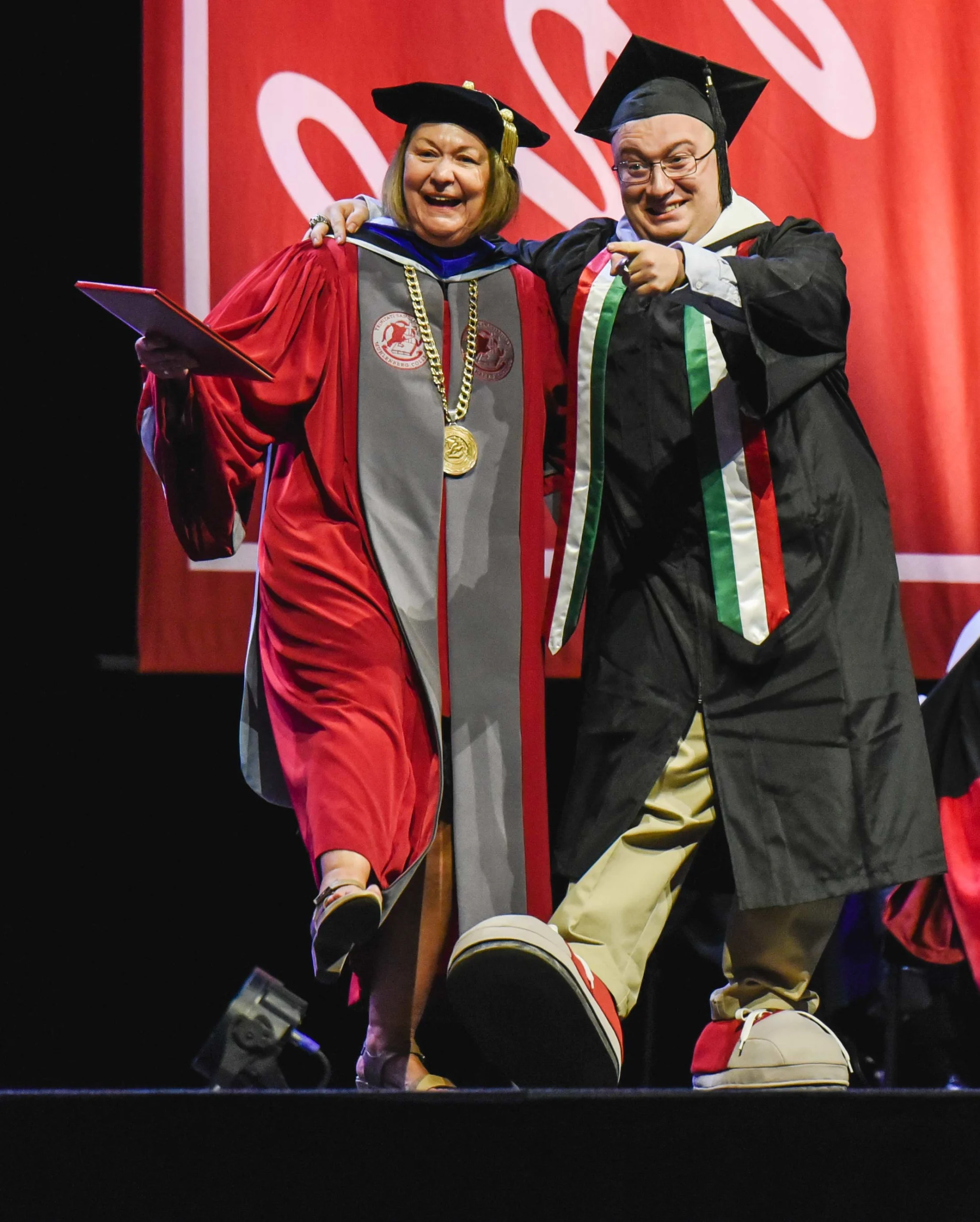
One of the most consistent Martis in Patruno’s memory was Michael Colasurdo ’23 (pictured at commencement in Marti’s shoes), a theatre major who is now part of the Carnival Cruise Line Fun Squad. He approached the athletic department early in his time at Muhlenberg because he wanted to sing the national anthem at football games. Patruno and Tubman liked his energy and asked him to be Marti.
“Not knowing what I was getting myself into, I said, ‘Heck yes, I want to be the mascot,’” Colasurdo says. “It was a very interesting outlet for me. As a mascot, you can’t talk. You have to be silent. It was interesting only performing with my physicality.”
Colasurdo remembers the same challenges as alumni who came before him — battling extreme heat, the stench of the suit — but he has, perhaps, put the skills he developed as a mascot to more use than anyone else. Last December, for example, he was at sea with the Carnival Jubilee, and he was again putting on a suit — a Santa suit. Beyond that, though, his day-to-day work running activities for people on vacation requires similar skills.
“Your job is to entertain people. You get out there and you are the best you you can possibly be. You have to be friendly. You have to be on all the time,” he says. “That is what I think Marti the Mule helped me achieve.”
Now, there are three students who take turns in the Marti suit as their schedules allow. They attend games and major college events (look for Marti at Red Door Weekend, October 16-18 — learn more here). They project excitement, enthusiasm, and happiness even as their nostrils are burning, their bodies are sweating, and their field of vision has narrowed to the inches-wide mesh circle inside Marti’s mouth. They’re hardworking, just like the animal they’re portraying.