Bucher is helping to build a community of critically minded educators who will support one another even after they’ve embarked on their teaching careers.
Associate Professor of Education Katie Bucher began her teaching career at an under-resourced elementary school in North Philadelphia. The school’s outside space was almost entirely covered in macadam, with a thin strip of grass running along the fence. At recess, Bucher found that her kindergarteners all gravitated to that tiny patch of green space.
“I’ve always been sort of a nature person. I’ve gardened since I was a kid,” Bucher says. Her students’ interest in that patch of grass inspired her: “I did some gardening activities with them. It was an entry point to making connections across content areas, but also, they enjoyed it. It brought them joy to see seeds that they had planted growing.”
She ultimately realized that her passion was for working with pre-service teachers — that is, educating future educators — and went back to school to obtain a master’s degree in international and comparative education and a doctorate in education policy. Her dissertation focused on school garden programs in Philadelphia and Havana, Cuba.
“Pennsylvania unfortunately does not have a lot of environmental education expectations for pre-service teachers, but I incorporate that focus where I can in my early childhood education coursework,” she says. “I talk about the mental and emotional benefits of spending time outdoors in a couple different courses.”
Associate Professor of Education Katie Bucher teaches The Arts in Education in spring 2026.
Prior to joining Muhlenberg in 2024, Bucher taught at the Community College of Philadelphia. She teaches courses in educational psychology, early childhood education, and second language acquisition. At the elementary school where she started her career, 75% of the students spoke Spanish as their primary language, and she taught in both English and Spanish. Bucher and her colleagues in Muhlenberg’s education department recently launched an English as a Second Language (ESL) certification program through the School of Continuing Studies.
“ESL is an area of high need,” she says. “Our job working with pre-service teachers is to do everything we can to make sure that the next wave of teachers is well prepared to support and work with multilingual learners.”
One of the strengths of Muhlenberg’s education program, Bucher says, is how early and often students are getting fieldwork experience. By the second semester taking education courses, students are in the field as active observers — not yet student-teaching, but “engaged in the life of the classroom, interacting with students, working one-on-one or with small groups,” she says. These early experiences help students learn whether teaching is a good fit for them.
If it is, as students progress through their time at the college, they’re given increasing amounts of responsibility in multiple educational settings. Muhlenberg has relationships with several local districts that are resourced very differently. Students are able to experience teaching in these unique environments and to learn from the full-time educators there about the challenges and opportunities inherent in their districts.
“Thinking about equity in schools is an important part of our coursework,” Bucher says. “It’s not just about strategies of teaching. It’s about being a critically minded educator.”
An education student’s time at Muhlenberg culminates in a “professional semester” in which they’re student-teaching full-time in two different placements. It’s an incredible amount of hours in the classroom and the field. Muhlenberg recently approved an elementary education major and a secondary education minor as a significant addition to its certification programs, “essentially recognizing the amount of work [students] were already doing,” Bucher says.
“Thinking about equity in schools is an important part of our coursework. It’s not just about strategies of teaching. It’s about being a critically minded educator.”
Bucher is working to involve students as she continues her research at Muhlenberg. One of her projects is a collaboration with the Mindful Child Initiative, a nonprofit that provides mindfulness activities to Allentown School District students. The organization has collected lots of data that needs analyzing, and Bucher is hoping that she and Muhlenberg students can work to assess the mindfulness programming the group has offered in outside spaces and its effects on elementary students’ health and well-being.
Bucher loves teaching at Muhlenberg, where the small class sizes are an additional advantage: “When students graduate from a teacher education program like this, where there is this sense of community, it can be a support network beyond graduation. Teachers feeling like they have a community of people who know what it means to teach is important,” she says. “For me, teaching is always relationship-driven, whether you’re working with preschoolers or adult learners.”
“For me, teaching is always relationship-driven, whether you’re working with preschoolers or adult learners.”
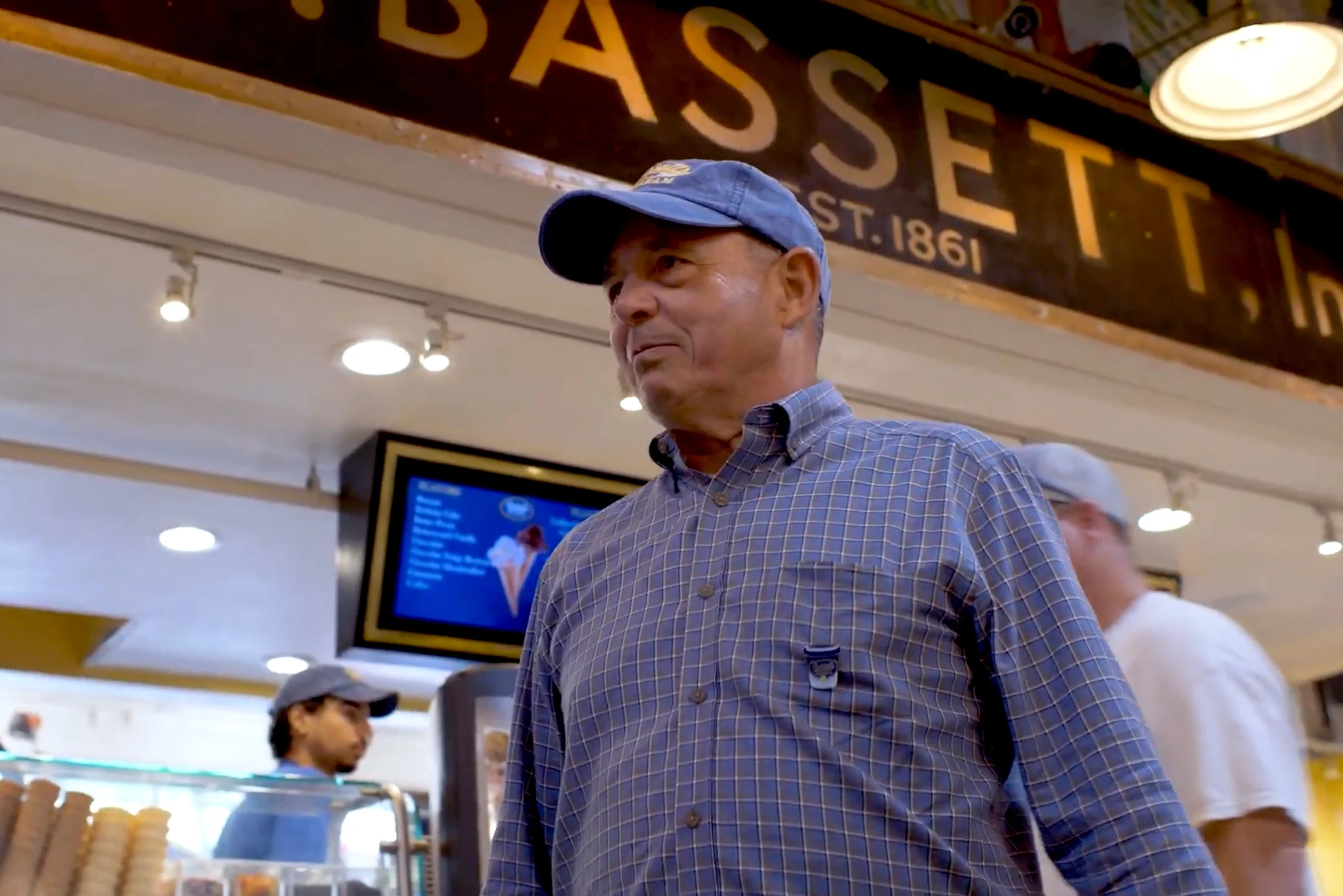
Strange, an accounting and business administration major at Muhlenberg, is CEO of Bassetts Ice Cream, the business that was started by his great-great-grandfather.